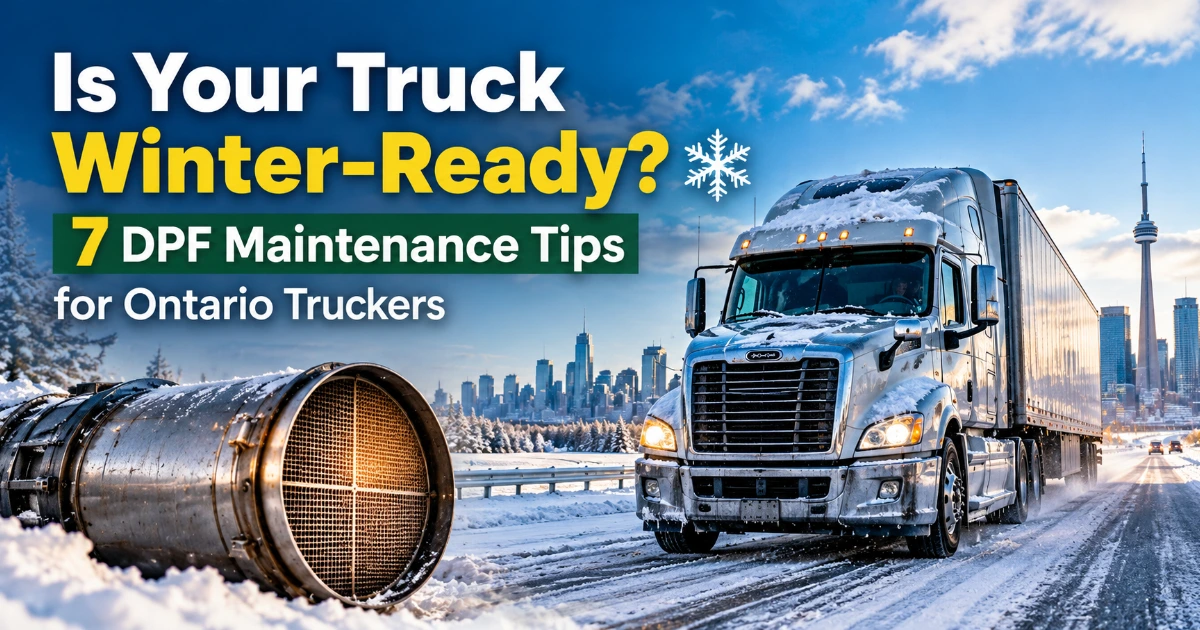
Winter DPF Maintenance Guide for Truck Drivers, Owner-Operators, and Fleet Managers in Ontario, Canada
Ontario winters can create challenging conditions for commercial truck drivers. Freezing temperatures, snow-covered roads, changing traffic conditions, long-distance deliveries, and demanding schedules make preventive truck maintenance an important part of winter preparation. Along with checking tires, batteries, coolant, and other essential components, truck owners should pay close attention to the diesel particulate filter (DPF) and the complete exhaust aftertreatment system.
A DPF-related warning, failed regeneration, or aftertreatment fault can interrupt a delivery schedule, reduce engine power, and lead to unexpected downtime. These issues are especially disruptive when a truck is operating far from its regular maintenance facility.
So, is your truck winter-ready? Before temperatures drop across Ontario, understanding how your DPF works, recognizing early warning signs, and scheduling appropriate maintenance can help you make informed decisions about your truck's condition.
At Evergreen Truck Service, we provide mobile DPF cleaning and diagnostic services for commercial trucks, helping owner-operators and fleet managers address their aftertreatment maintenance needs conveniently.
In this guide, we explore seven practical DPF maintenance tips for Ontario truckers, explain common winter-related concerns, and discuss when professional DPF cleaning may be appropriate.
Why Is DPF Maintenance Important During an Ontario Winter?
A diesel particulate filter is an essential component of a modern diesel engine's exhaust aftertreatment system. It captures particulate matter, including soot, from the exhaust before it is released into the atmosphere.
Over time, soot accumulates inside the filter and must be burned off through a process called regeneration. Non-combustible ash also accumulates as the filter is used, and it cannot be removed through normal regeneration.
During winter, driving conditions and operating patterns can influence how the engine and aftertreatment system perform. Frequent short trips, extended idling, interrupted regeneration, and certain engine or sensor faults may contribute to DPF-related problems.
However, cold weather alone does not mean that a DPF will fail. The actual condition of the filter, engine operating temperature, driving cycle, maintenance history, and vehicle-specific requirements all matter.
For truck drivers travelling across Toronto, Mississauga, Brampton, Hamilton, Ottawa, London, Windsor, and other Ontario locations, including DPF maintenance in the seasonal service plan can help identify issues before they create bigger operational challenges.
7 Essential DPF Maintenance Tips for Ontario Truckers
1. Inspect Your DPF Before Winter Arrives
One of the most practical steps in preparing a diesel truck for winter is checking the condition of the DPF before the coldest weather arrives.
A DPF may gradually accumulate soot and ash during normal operation. If the filter becomes excessively restricted, exhaust flow can be affected, potentially contributing to warning lights, regeneration problems, or reduced engine performance.
Waiting until a warning appears may leave you with fewer convenient maintenance options, particularly when your truck is committed to a long-distance delivery schedule.
What should you check before winter?
Review your truck's maintenance and DPF cleaning history.
Look for recurring DPF or aftertreatment warning messages.
Pay attention to repeated or unsuccessful regeneration attempts.
Check whether the manufacturer-recommended DPF inspection or cleaning interval is approaching.
Arrange a professional assessment if there are signs of restriction or other aftertreatment problems.
Remember that not every DPF requires cleaning before winter. The correct maintenance decision depends on the filter's condition, diagnostic information, service history, and manufacturer recommendations.
For truck owners looking for DPF cleaning in Ontario, Canada, a professional assessment can help determine whether cleaning is necessary or whether another fault needs attention.
Evergreen Truck Service offers mobile DPF cleaning and diagnostic services to help truck owners address their maintenance requirements.
Winter maintenance tip: Do not wait for a severe warning or derate condition before investigating recurring DPF problems.
2. Understand DPF Regeneration and Avoid Repeated Interruptions
DPF regeneration is the process through which accumulated soot is oxidized at sufficiently high temperatures. Depending on the vehicle and its operating conditions, regeneration may occur automatically, be initiated by the driver, or require a workshop procedure.
During Ontario's winter months, some trucks may experience operating patterns that make successful regeneration more difficult. Frequent short journeys, extended idling, low engine loads, or repeated shutdowns can prevent certain vehicles from completing their normal regeneration cycle.
This does not mean that every short trip or period of idling will cause a DPF problem. The effect depends on the engine design, emissions system, duty cycle, and operating conditions.
How can truck drivers manage regeneration properly?
Understand the DPF warning indicators in your truck's manual.
Follow the manufacturer's instructions when a regeneration request appears.
Avoid repeatedly interrupting regeneration when it is safe and appropriate to allow the process to finish.
Do not attempt a parked regeneration in an unsafe location or when operating conditions prohibit it.
Seek professional diagnostics if regeneration repeatedly fails or warning messages return.
It is also important to distinguish normal regeneration from a filter that needs professional cleaning. Regeneration burns soot, but it does not remove accumulated ash from the DPF.
If your truck frequently requests regeneration or continues to display a DPF warning after regeneration, there may be a restriction, sensor issue, engine problem, or another fault that requires investigation.
Evergreen Truck Service can help truck owners assess DPF-related concerns through appropriate diagnostic and cleaning services.
Key takeaway: Proper regeneration practices support DPF operation, but repeated regeneration problems should not be ignored.
3. Know the Difference Between DPF Soot and Ash
Understanding the difference between soot and ash is essential for maintaining a diesel particulate filter.
Although both materials accumulate in the filter, they behave differently and require different maintenance approaches.
Soot: Soot is combustible particulate matter produced during diesel engine operation. Under suitable conditions, the regeneration process burns much of this accumulated soot.
Ash: Ash is non-combustible material that accumulates over time, including residues associated with engine oil additives and other sources. Normal DPF regeneration does not eliminate this ash.
As ash accumulates, it can reduce the filter's available capacity and contribute to increasing restriction. The appropriate cleaning interval depends on the engine manufacturer's guidance, the vehicle's duty cycle, mileage, and diagnostic findings.
A dashboard warning does not automatically mean that ash is the problem. Sensor faults, engine issues, excessive soot loading, and other aftertreatment problems can produce similar symptoms.
When might professional DPF cleaning be appropriate?
When the filter has accumulated ash and is due for cleaning.
When testing or inspection indicates excessive restriction.
When the manufacturer's maintenance schedule calls for cleaning.
When a qualified assessment confirms that cleaning is suitable for the filter's condition.
Cleaning must be performed using a process appropriate for the specific filter. A damaged, cracked, melted, or otherwise compromised DPF may require repair or replacement rather than cleaning.
For Ontario truckers, understanding the difference between soot and ash can help prevent unnecessary regeneration attempts and support better maintenance decisions.
Evergreen Truck Service provides DPF cleaning services for trucks that need professional attention to their exhaust filters.
Remember: Regeneration burns soot. Appropriate professional cleaning can remove accumulated ash when the filter is suitable for cleaning.
4. Pay Attention to DPF Warning Lights and Early Symptoms
A DPF warning light is a signal that your truck's aftertreatment system requires attention. Depending on the vehicle, the warning may indicate a need for regeneration, excessive soot loading, a system malfunction, or another condition described in the manufacturer's instructions.
Ignoring a warning or continuing to operate a truck without understanding the fault can increase the risk of further complications.
Ontario truckers should pay attention to changes in vehicle performance, especially before starting long-haul trips during winter.
Common DPF-related warning signs include:
A DPF warning light that remains illuminated.
Repeated regeneration requests.
Failed or incomplete regeneration cycles.
Reduced engine power or a derate warning.
Diagnostic fault codes related to the exhaust aftertreatment system.
A reported exhaust restriction or abnormal differential-pressure reading.
These symptoms are not exclusive to a dirty DPF. For example, a faulty pressure sensor, damaged wiring, an exhaust leak, an engine problem, or an SCR system fault may also affect aftertreatment operation.
The appropriate response depends on the warning, fault codes, and manufacturer instructions. If the vehicle displays a critical warning or severe power restriction, follow the manufacturer's safety guidance and arrange qualified assistance as needed.
What should you do if your truck displays a DPF warning?
First, identify the warning and consult the vehicle manual. Next, determine whether the truck requires a permitted regeneration procedure or professional diagnostics. Avoid assuming that cleaning alone will resolve the problem.
Evergreen Truck Service offers DPF diagnostics and cleaning services to help truck owners investigate aftertreatment issues and determine the appropriate next step.
Winter reminder: Early diagnosis may help prevent avoidable delays, but no maintenance service can guarantee that a truck will never experience a breakdown.
5. Don't Overlook Sensors and the Complete Aftertreatment System
A diesel truck's emissions system is more complex than the DPF alone. Depending on the vehicle, the aftertreatment system may include a diesel oxidation catalyst (DOC), selective catalytic reduction (SCR) system, exhaust gas recirculation (EGR) system, turbocharger, and multiple sensors.
These components perform different functions, but faults in one area can sometimes affect the operation of another.
For example, a faulty differential-pressure sensor may provide incorrect information about DPF restriction. An exhaust temperature sensor problem can interfere with regeneration control. Engine issues may increase soot production, while SCR-related faults can trigger separate emissions warnings or operating limitations.
Winter preparation should therefore include attention to the complete system rather than relying on DPF cleaning alone.
Important areas to consider include:
DPF: Check for soot loading, ash accumulation, excessive restriction, and signs of damage.
DOC: Investigate relevant fault codes and assess the component when diagnostic findings indicate a problem.
SCR: Respond to emissions-system warnings and faults according to the vehicle manufacturer's instructions.
EGR: Investigate faults that may affect combustion, emissions, or engine performance.
Turbocharger: Check for relevant performance problems, boost-related faults, and conditions that may contribute to abnormal exhaust output.
Sensors and wiring: Investigate temperature, pressure, and other sensor faults that may interfere with aftertreatment operation.
These systems should not automatically be cleaned or replaced simply because winter is approaching. Proper diagnostics help determine which components require service.
Evergreen Truck Service provides aftertreatment cleaning and diagnostic services, including services relating to DPF, DOC, SCR, EGR, and turbo systems, where applicable.
The goal is to identify the underlying issue, not simply clear a warning and hope it does not return.
6. Manage Winter Idling and Cold-Weather Driving Patterns
Cold-weather operations can change how truck drivers use their vehicles. Drivers may idle for longer periods to maintain cabin comfort, operate at low loads while moving through traffic, or make frequent stops during delivery routes.
Depending on the engine and aftertreatment design, these operating patterns may affect exhaust temperatures and the conditions needed for regeneration.
Extended idling can also increase fuel consumption and contribute to emissions-related maintenance concerns. However, idling restrictions, cold-weather requirements, and safe operating practices vary by vehicle and location.
Practical tips for Ontario truck drivers:
Follow the manufacturer's recommendations for cold starts and engine warm-up.
Avoid unnecessary extended idling when safe and permitted alternatives are available.
Understand how your vehicle manages regeneration during low-load operation.
Pay attention to recurring DPF warnings during short-trip or stop-and-go operations.
Use approved engine and aftertreatment operating procedures.
Have repeated regeneration problems investigated rather than relying on driving patterns alone to resolve them.
Do not attempt to force regeneration simply by driving at high speed or increasing engine load. Follow the vehicle's instructions and seek qualified assistance if the system cannot complete regeneration normally.
Truck drivers operating in and around the Greater Toronto Area, Brampton, Mississauga, Hamilton, and other Ontario freight corridors should consider their typical duty cycle when planning DPF maintenance.
For trucks that spend significant time idling or operating at low loads, an assessment of the actual DPF condition and maintenance history can be particularly useful.
Remember: Driving habits matter, but persistent aftertreatment faults need proper diagnosis.
7. Schedule Professional DPF Cleaning Before a Problem Interrupts Your Route
The final step in preparing your truck for winter is making sure its maintenance plan addresses any confirmed DPF cleaning requirements before they become an urgent operational problem.
Professional DPF cleaning typically involves assessing the filter's condition, using an appropriate cleaning process, and checking the result where the service procedure supports such testing. The exact process varies according to the equipment, filter design, and service provider.
Not every filter can be restored through cleaning. A qualified technician should identify damage or other conditions that make cleaning unsuitable.
For owner-operators, arranging maintenance in advance may make it easier to coordinate service around delivery schedules. Fleet managers can also use maintenance records and diagnostic information to plan servicing for vehicles with known DPF concerns.
When should you consider professional DPF cleaning?
When the manufacturer's recommended service interval has been reached.
When accumulated ash or excessive restriction has been confirmed.
When an inspection indicates that cleaning is appropriate.
When recurring DPF problems require an assessment to determine whether cleaning is part of the solution.
Avoid choosing a cleaning interval based only on a universal mileage figure. Different engines, operating conditions, and filter designs have different service requirements.
Why Consider Mobile DPF Cleaning in Ontario?
Taking a commercial truck to a workshop can require additional scheduling and transportation arrangements. Mobile DPF cleaning can offer an alternative when the truck, location, and required service are suitable for on-site work.
Evergreen Truck Service provides mobile DPF cleaning and diagnostic services for truck owners in its Ontario service area. Mobile service can be especially convenient for owner-operators and fleet managers who need to coordinate maintenance around active operations.
Before booking, confirm whether the required cleaning or diagnostic procedure can be completed at your location, whether the truck needs to be taken out of service, and what access or preparation is required.
Need mobile DPF cleaning in Ontario? Contact Evergreen Truck Service to discuss your truck's symptoms, service requirements, and location.
Other Essential Winter Maintenance Checks for Diesel Trucks
Although this article focuses on DPF maintenance, winter readiness requires a broader approach. A properly maintained DPF cannot compensate for problems elsewhere in the vehicle.
Before winter operations begin, consider including the following checks in your maintenance plan:
Battery and charging system: Check battery condition, connections, and charging performance.
Coolant and antifreeze: Confirm that the coolant mixture and condition meet manufacturer specifications for expected temperatures.
Engine oil: Use the oil grade and specification recommended for your engine and operating conditions.
Fuel system: Follow the manufacturer's cold-weather diesel fuel recommendations and maintain appropriate fuel-filter service intervals.
Tires: Check tread condition, inflation, and suitability for winter operating conditions.
Brakes and air system: Inspect braking components and follow the recommended procedures for managing moisture in the air system.
Lights and visibility: Check headlights, brake lights, wipers, and washer fluid suitable for winter temperatures.
Belts, hoses, and leaks: Inspect for wear, damage, and signs of fluid leakage.
Emergency equipment: Carry appropriate winter emergency supplies and equipment for commercial vehicle operations.
Maintenance requirements vary by truck model, engine, duty cycle, and operating environment. Consult the manufacturer's maintenance schedule and have concerns assessed by a qualified technician.
How Can Evergreen Truck Service Help Ontario Truckers Prepare for Winter?
Evergreen Truck Service supports truck owners and fleet operators with mobile DPF cleaning and related aftertreatment services.
Preparing for winter is an opportunity to review known maintenance needs, address recurring warning signs, and arrange appropriate service before a problem disrupts a scheduled haul.
Our services include:
Mobile DPF Cleaning: Professional diesel particulate filter cleaning when the filter's condition and service requirements make cleaning appropriate.
DPF Diagnostics: Assistance with investigating DPF-related warnings, restrictions, and diagnostic fault codes.
DOC, SCR, EGR, and Turbo Cleaning: Services for relevant aftertreatment and engine components, subject to component condition and service suitability.
Carbon Cleaning: Professional carbon cleaning services for applicable engine-related maintenance needs.
Hydrogen Engine Cleaning: A service option for applicable vehicles and maintenance requirements. Suitability should be assessed for the specific engine and procedure.
If your truck has a DPF warning, recurring regeneration problem, or suspected aftertreatment restriction, a proper assessment can help determine whether cleaning, repairs, or further diagnostics are required.
Mobile service availability depends on the truck's location, the requested work, and whether the necessary procedure can be performed on-site.
Contact Evergreen Truck Service to discuss your winter maintenance requirements and arrange service in our Ontario coverage area.
Website: https://evergreentruckservice.com/
Frequently Asked Questions About Winter DPF Maintenance in Ontario
1. Does cold weather affect a diesel particulate filter?
Cold weather can influence engine warm-up, exhaust temperatures, and operating conditions that affect regeneration. Short trips, extended idling, interrupted regeneration, and existing engine or sensor faults may contribute to DPF problems. Cold weather alone does not automatically mean the filter will become blocked.
2. Should I clean my DPF before winter in Ontario?
Not every truck needs DPF cleaning before winter. Cleaning may be appropriate when the filter has accumulated ash, excessive restriction has been confirmed, or the manufacturer's maintenance schedule calls for it. An inspection and diagnostic assessment can help determine whether cleaning is necessary.
3. Can regeneration remove all the soot and ash from a DPF?
Regeneration burns accumulated combustible soot under suitable conditions. It does not remove non-combustible ash. When ash accumulation or excessive restriction requires attention, professional cleaning may be appropriate if the filter is in a suitable condition.
4. What are the common signs of a DPF problem in winter?
Possible signs include a persistent DPF warning, repeated regeneration requests, unsuccessful regeneration, reduced engine power, and relevant diagnostic fault codes. These symptoms can have multiple causes, so professional diagnostics may be needed to identify the underlying issue.
5. Can a blocked DPF cause a truck to derate?
Yes. Excessive DPF restriction or certain related aftertreatment faults can contribute to reduced engine power or derate conditions, depending on the vehicle's control system. Other engine, sensor, and emissions-system problems can also cause derating. Follow the vehicle manufacturer's instructions when a derate warning appears.
6. How often should a truck's DPF be cleaned?
There is no single cleaning interval that applies to every diesel truck. The appropriate interval depends on the engine and filter design, mileage, duty cycle, operating conditions, maintenance history, and manufacturer guidance. Diagnostic findings can help determine when cleaning is necessary.
7. Is mobile DPF cleaning available in Ontario, Canada?
Evergreen Truck Service offers mobile DPF cleaning and diagnostic services in its Ontario service area. Contact the company to confirm coverage for your location and whether your truck's required service can be completed on-site.
8. Can DPF cleaning fix every DPF warning or derate problem?
No. Cleaning can address suitable filters with accumulated soot or ash, but it cannot repair every underlying fault. Damaged filters, faulty sensors, exhaust leaks, engine problems, and other aftertreatment faults may require additional diagnostics, repairs, or component replacement.
9. What should I do if my truck repeatedly fails regeneration?
Follow the vehicle manufacturer's instructions and investigate the cause rather than repeatedly attempting regeneration without understanding the problem. A qualified technician may need to check soot loading, differential pressure, temperature sensors, engine conditions, and related fault codes.
10. How can I book mobile DPF cleaning with Evergreen Truck Service?
Visit https://evergreentruckservice.com/ or contact Evergreen Truck Service to discuss your truck's location, warning signs, and service requirements. Confirm service availability and the suitability of on-site cleaning before arranging the appointment.
Conclusion: Get Your Truck Winter-Ready Before the Cold Sets In
Ontario winters demand careful preparation from truck drivers, owner-operators, and fleet managers. While DPF maintenance is only one part of winter readiness, understanding regeneration, recognizing warning signs, monitoring aftertreatment performance, and arranging appropriate cleaning can help you manage maintenance more effectively.
Start by reviewing your truck's service history, checking for recurring DPF warnings, and investigating any unresolved regeneration or performance problems. Include the complete aftertreatment system in your maintenance plan rather than assuming every issue can be solved by cleaning the DPF alone.
If your truck needs professional DPF cleaning or diagnostic support, Evergreen Truck Service offers mobile services in its Ontario service area to help you address your maintenance requirements.
Don't wait for an unresolved DPF problem to disrupt your next haul. Plan your winter maintenance, address warning signs early, and contact Evergreen Truck Service to discuss your mobile DPF cleaning needs.
Evergreen Truck Service — Mobile DPF Cleaning and Diagnostics in Ontario, Canada.
Website: https://evergreentruckservice.com/
Book your service today and prepare your truck for the winter road ahead.