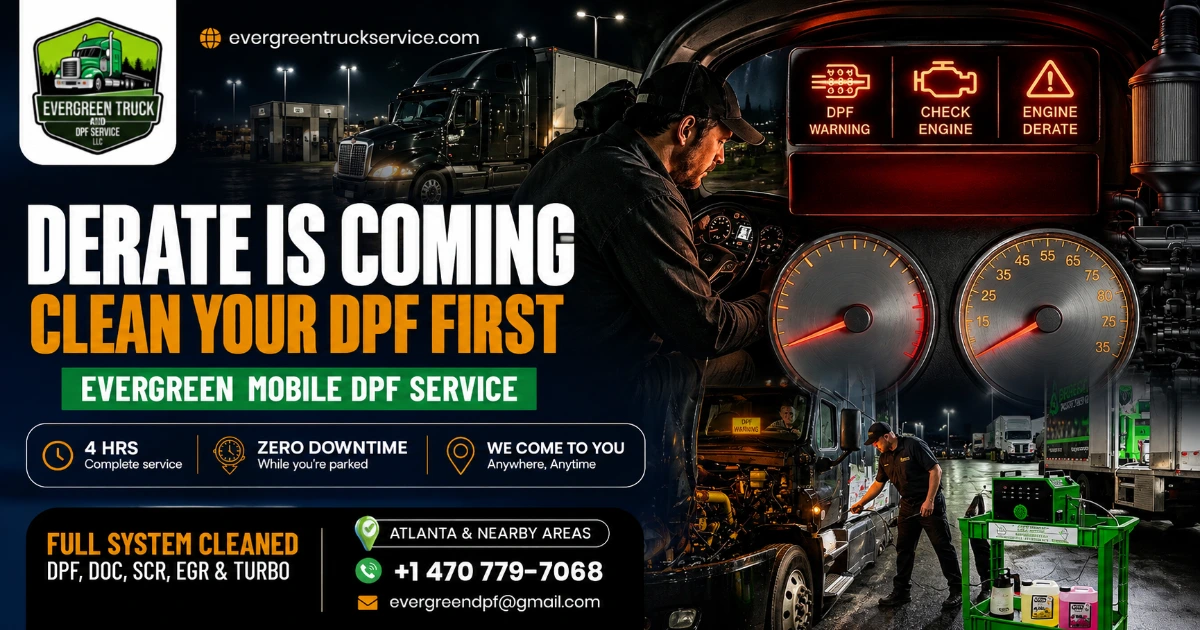
Derate Warning Light On? Here’s Why (And How to Fix It in Under 4 Hours)
Mobile DPF & Aftertreatment Service | Atlanta, GA
What Causes a Derate Warning Light?
A derate warning light comes on when your truck’s engine computer detects that the diesel particulate filter (DPF) is clogged with soot, ash, or oil residue beyond a safe threshold, and it automatically cuts engine power to protect the aftertreatment system. In most cases, the direct cause is a blocked DPF that has triggered excessive backpressure, though a failing DOC, SCR, or EGR system can also send your truck into limp mode. If you’re searching for a fix to get that light off and your power back, the short answer is: a professional mobile DPF cleaning can usually clear the blockage and restore full power in under 4 hours, without ever removing the unit.
Understanding the Warning: Amber vs. Red
Most Atlanta owner-operators first notice an amber dash light, which signals that the DPF is filling up and a regen cycle is needed soon. If ignored, that amber light turns red, and the engine control module will begin reducing horsepower, then torque, until the truck is crawling at idle speed. This is the truck’s built-in defense mechanism against catastrophic aftertreatment damage. Drivers dealing with this at this stage are usually past the warning phase and already losing power on the move. The good news is that even a red derate light doesn’t mean you need a new filter — it almost always means the DPF needs a proper deep clean, which is exactly what a mobile DPF cleaning service is built to handle, anytime and anywhere you’re parked.
The Real Reasons Your DPF Clogs in the First Place
A handful of everyday driving conditions accelerate DPF clogging far faster than most drivers expect. Frequent short hauls and stop-and-go city driving around Atlanta prevent the filter from reaching the high exhaust temperatures it needs for a passive regen, allowing soot to build up steadily. Idling for long periods at distribution centers or rest stops adds to the problem, since idle exhaust temperatures rarely get hot enough to burn off accumulated particulate matter. Low-quality diesel fuel and degraded engine oil also contribute heavily to ash buildup, which a simple forced regen cannot remove. This is exactly why so many fleet managers now look for a proper deep clean instead of relying on forced regens alone — a true cleaning removes carbon, soot, oil, and ash together, not just the soot.
Why Forced Regens Aren’t a Permanent Fix
Forced regeneration burns off loose soot, but it does nothing for the oil ash and sintered ash that bond to the filter’s ceramic walls over time. That’s why a truck can go through repeated forced regens and still throw a derate code weeks later — the underlying restriction was never actually removed. Atlanta drivers who repeatedly search for help after multiple failed regens are often dealing with ash saturation, which only a chemical or hydrogen-based deep clean can resolve. A patented cleaning process strips all four blocking elements — carbon, soot, oil, and ash — restoring the filter close to factory-new flow, all completed on-site without removing the DPF unit or risking damage to brackets, clamps, or sensors.
Signs You Need DPF Service Before the Light Even Comes On
Smart drivers don’t wait for a full derate event. Watch for these early indicators, then book a professional mobile DPF cleaning before you’re stuck on the side of the lot losing income:
• Noticeably reduced fuel economy over the past few weeks
• More frequent regen cycles than usual, sometimes several times a day
• Sluggish acceleration or a noticeable loss of power under load
• A burning or unusually strong exhaust smell inside the cab
• Rising exhaust backpressure readings on diagnostic scans
Catching any of these early means a routine cleaning instead of an emergency roadside repair call at 2 a.m. A trusted mobile provider offers full diagnostics alongside every cleaning, so technicians can confirm whether the DOC, SCR, or turbocharger is also contributing to the problem before it leads to a full derate.
What Happens During a Professional Mobile DPF Cleaning
When you book a mobile DPF service, a certified technician comes to your location — your yard, your dock, or wherever your truck is parked — with everything needed to complete a full DPF service on-site. The process starts with a diagnostic scan to confirm the derate is actually DPF-related and to check related systems like the DOC, SCR, EGR, and turbocharger. From there, the technician performs a deep hydrogen and chemical cleaning that dissolves carbon, soot, oil, and ash without ever pulling the filter off the truck. Every job ends with testing and a quality check before you’re cleared to roll. This is the core reason Atlanta fleets keep choosing this approach — the entire job, from arrival to clearance, is typically finished and your truck is back on the road in under 4 hours.
Mobile Service: Anytime, Anywhere, No Shop Wait
Every hour your truck sits derated is an hour of lost income, missed pickup windows, and frustrated dispatchers. That’s why the best mobile providers build their entire model around service available anytime, anywhere — no towing to a shop, no waiting in line behind other trucks, and no scheduling around a shop’s business hours. Whether you’re parked at a distribution center, a fleet yard, or a rest area anywhere across the greater Atlanta area, a technician can reach you and get to work immediately. For owner-operators and fleet managers, this on-demand, come-to-you model is the difference between a half-day delay and a multi-day shop backlog.
Why On-Site Cleaning Beats Shop-Based Alternatives
Traditional shop-based DPF removal involves hours of labor, the risk of damaged brackets, clamps, and sensors during removal and reinstallation, and days of downtime waiting for a slot. A no-removal cleaning process avoids all of that. Beyond speed, the deeper clean extends DPF life significantly, since a filter that’s actually been stripped of carbon, soot, oil, and ash burns more efficiently and resists future clogging longer than one that’s only been through repeated forced regens. Lower long-term operating costs, fewer repeat derates, and a fraction of the cost of a brand-new filter are exactly why fleet managers across Atlanta now treat mobile cleaning as their go-to solution whenever a derate code appears, rather than defaulting to a dealership or full-service shop.
Preventing the Next Derate Before It Happens
Prevention is always cheaper than an emergency call. Scheduling a routine DPF and engine carbon cleaning every few months — rather than waiting for a warning light — keeps backpressure low and regen frequency normal, which protects fuel economy and engine performance year-round. Fleet managers running multiple trucks often set up recurring service windows with a trusted provider so that derates become a rare exception instead of a routine disruption. If you’ve been putting off maintenance and only acting after a dash light forces the issue, switching to a proactive schedule is the single biggest change you can make to protect both uptime and your bottom line.
How Much Does DPF Cleaning Cost Compared to Replacement?
A new DPF unit can run into the thousands of dollars once you factor in parts and labor, and that’s before accounting for the days of downtime while you wait for the part to arrive and get installed. A professional cleaning costs a fraction of that price and, because the original filter is restored rather than replaced, you avoid the disposal cost and environmental impact of scrapping a unit that still has years of life left in it. This cost gap is exactly why so many owner-operators who choose mobile cleaning over replacement are pleasantly surprised once they compare the invoice against a dealership replacement quote. For fleet managers running several trucks, the savings multiply fast — and the eco-friendly process means less waste sent to landfills, since fewer filters need to be scrapped each year.
DPF, DOC, SCR, or Turbo — How to Know What’s Actually Failing
Not every derate code points straight to the DPF. A failing diesel oxidation catalyst (DOC) can mimic DPF symptoms by preventing proper passive regeneration, while SCR system faults often trigger a separate but related set of fault codes tied to emissions compliance rather than backpressure. A struggling turbocharger can also reduce exhaust flow enough to accelerate soot buildup, making the DPF look like the root cause when it’s really a downstream symptom. This is why a proper diagnostic scan matters as much as the cleaning itself — guessing wrong means paying for a service that doesn’t fix the actual problem. Certified technicians run full diagnostics across the DPF, DOC, SCR, EGR, and turbocharger before recommending a fix, so drivers get an accurate answer instead of a guess.
What Atlanta Fleet Managers Should Know About Scheduling Service
Running a fleet means juggling multiple trucks on tight delivery windows, and a single derated truck can throw off schedules across an entire route. Fleet managers who build a relationship with a trusted mobile provider avoid the scramble of last-minute searches every time a warning light appears. A reliable provider works directly with dispatchers and fleet managers to schedule cleanings around existing routes, batch multiple trucks in a single yard visit, and flag early warning signs during diagnostics before they become full derates. Warranty-backed work and lifetime customer support also mean fleets aren’t left guessing if an issue resurfaces — a follow-up visit is always just a call away.
Frequently Asked Questions
How long does it take to fix a derate caused by a clogged DPF?
With a professional mobile DPF cleaning, most Atlanta trucks are back on the road in under 4 hours from the time the technician arrives, since the filter never has to be removed or shipped out for cleaning.
Can a derate be fixed without removing the DPF?
Yes. A proper hydrogen and chemical cleaning process cleans the filter in place, which avoids the labor cost and risk of damaged brackets, clamps, or sensors that comes with a full removal and reinstall.
Is mobile DPF service available anywhere in Atlanta?
Yes — trusted mobile providers come to your location anytime, anywhere across the greater Atlanta area, whether you’re parked at a yard, a dock, or a rest stop, with no need to tow your truck to a shop.
In Conclusion: Evergreen Truck Service Gets You Back on the Road, Fast
A derate warning light is stressful, but it doesn’t have to mean lost days or an expensive filter replacement. Evergreen Truck Service provides mobile DPF cleaning, full diagnostics, hydrogen engine cleaning, and complete aftertreatment servicing — covering the DPF, DOC, SCR, EGR, turbocharger, and combustion system — for drivers and fleets across Atlanta who need a fast, reliable, on-site fix. Technicians come to you anytime, anywhere, with most trucks back on the road in under 4 hours. From diagnostics to deep cleaning to final testing, every step is handled by certified technicians using advanced hydrogen and chemical cleaning technology, with no DPF removal and no multi-day shop wait. If you’re seeing that warning light right now or just want to stay ahead of the next one, Evergreen Truck Service is ready to help.
Get Back on the Road — Book Evergreen Truck Service Today
Call or WhatsApp: +1 470 779-7068
Email: evergreendpf@gmail.com
Website: evergreentruckservice.com
Mobile DPF cleaning, diagnostics, and aftertreatment service — available anytime, anywhere across Atlanta. Book now and get back on the road in under 4 hours.