How Ontario Winter Destroys Fuel Efficiency
The DPF Maintenance Factor You’re Ignoring
Ontario trucking operations burn through fuel budgets faster in winter. But most fleet managers don’t realize the real culprit: neglected DPF systems. A clogged diesel particulate filter doesn’t just reduce power—it silently destroys your fuel economy and profits.
This guide reveals exactly how much a clogged DPF costs you, and why winter makes it dramatically worse.
1. The Winter Fuel Efficiency Problem
Winter diesel in Ontario isn’t just cold—it burns differently.
The Problem:
• Cold diesel (#2) gels at -15°C, becoming sluggish
• Incomplete combustion = more soot production
• Soot clogs DPF 30% faster than summer
• Engine works harder → uses 15–25% more fuel
• GTA stop-start traffic prevents proper DPF regeneration
2. The DPF Clog Fuel Penalty
A clogged DPF forces your engine to work harder. Here’s what the numbers look like across three filter conditions (per truck at 150,000 km/year):
A Clean DPF delivers the best fuel economy, typically in the range of 25–28 litres per 100 km, with an estimated annual fuel cost of around $12,000. This is the baseline every Ontario fleet should be targeting and protecting.
A Partially Clogged DPF tells a different story. Once soot and ash accumulation reaches a moderate level, fuel consumption climbs to 29–32 L/100km—a jump that translates to approximately $15,200 per year in fuel costs for that single truck. The deterioration is gradual enough that many operators never notice it happening, which is precisely what makes it so expensive.
A Heavily Clogged DPF is where costs become critical. At this stage, fuel economy collapses to 35–40 L/100km, pushing annual fuel expenditure past $20,000 per truck. At this point the engine is also at risk of turbocharger damage, forced regeneration failures, and eventual limp-mode shutdown—all of which carry additional repair and downtime costs on top of the fuel penalty.
3. Real-World Ontario Fleet Impact
Example: 10-Truck Regional Fleet
Let’s say 5 trucks have undiagnosed, partially-clogged DPFs:
1. Clean fleet baseline: 27 L/100km = $120,000/year total
2. 5 clogged trucks: 32 L/100km = $152,000/year for those 5
3. Other 5 clean: 27 L/100km = $120,000/year
4. Fleet total: $272,000/year (vs $240,000 if all clean) = $32,000 extra fuel cost
4. Why Winter Makes It Worse
December–February adds a 15–30% efficiency penalty:
• Diesel #2 fuel gels = poor combustion
• Engine idling to warm up = wasted fuel
• DPF regeneration cycle fails (too cold for proper burn)
• Stop-start GTA traffic = zero highway-driven regeneration
• Tire grip = increased rolling resistance = 5–8% worse economy
5. Prevention: The Only Profitable Solution
Ignoring DPF maintenance is like ignoring an oil change. It starts small and ends expensive.
Cleaning every 60,000 km at a cost of $450–$600 per service keeps your filters operating at optimal flow and maintains peak fuel economy. This is the proactive scenario—planned, budgeted, and almost entirely free of unpleasant surprises.
Choosing to ignore the issue and hoping the system self-manages costs nothing upfront but results in a 15–25% fuel economy penalty that compounds every month the filter goes unserviced. Over a full year, that lost efficiency easily exceeds $3,000–$6,000 per truck—far more than a cleaning would have cost.
Waiting for a full failure is the most expensive outcome. Emergency DPF replacement, towing, and unplanned repair bills typically run $5,000–$8,000, and that doesn’t account for 8–16 hours of downtime per truck or the 30–40% fuel efficiency degradation that accelerates in the weeks before a catastrophic failure event.
6. Your November Action Plan
Don’t wait for winter problems. Do this before December:
1. Week 1: Diagnostic scan on all trucks (identifies clogged filters)
2. Weeks 2–3: Schedule DPF cleaning for flagged vehicles
3. Week 4: Track fuel consumption baseline (compare winter vs spring)
4. Ongoing: Monthly fuel metrics (early warning system)
Why Ontario Winter and Neglected DPFs Are Draining Your Fleet Budget
The Problem No One Talks About at the Fuel Pump
Every Ontario fleet manager knows the feeling of watching fuel costs climb through the winter months and attributing it to the usual suspects: colder temperatures requiring longer warm-up idling, denser air affecting aerodynamic drag, winter-blend diesel pricing, and the relentless stop-and-go of GTA freight corridors clogged with snow removal vehicles and cautious commuters. These factors are real, and they do affect your fuel budget. But there is a variable that most fleet managers are not tracking—one that quietly multiplies every other winter inefficiency and turns a manageable seasonal cost increase into a serious annual budget problem.
That variable is your diesel particulate filter.
A partially or heavily clogged DPF does not announce itself loudly. There is no single moment where the driver reports that the truck suddenly became dramatically less fuel efficient. Instead, the degradation happens gradually over tens of thousands of kilometres, the engine management system quietly compensates with more fuel and more aggressive regeneration cycles, and the fleet manager sees the fuel bill creeping upward without a clear explanation. By the time a fault code finally triggers or a truck enters limp mode, the fleet has already been haemorrhaging money for months.
This guide is designed to give Ontario fleet managers and owner-operators the complete picture: how Ontario’s winter operating environment interacts with DPF health, what the actual financial cost of neglect looks like at the fleet level, and why mobile DPF cleaning from Evergreen Truck DPF Services is the most practical and cost-effective solution available to Ontario trucking operations in 2026.
Understanding the DPF’s Role in Fuel Efficiency
Before we can understand why a clogged DPF costs money, it helps to understand exactly what the filter is doing and what happens when it cannot do its job properly.
The diesel particulate filter is positioned in the exhaust stream and captures the fine soot particles produced by diesel combustion. This is not optional equipment—it is federally mandated on all diesel engines manufactured from 2007 onward in Canada and the United States, and tampering with or removing it carries significant legal and financial penalties.
The DPF works in combination with the rest of the aftertreatment system: the diesel oxidation catalyst (DOC) that prepares exhaust gases entering the filter, the selective catalytic reduction (SCR) system that handles nitrogen oxide reduction downstream, and the exhaust gas recirculation (EGR) valve that reduces combustion temperatures at the source. These systems are interdependent. A compromised DOC means the DPF never reaches the temperatures needed for self-cleaning regeneration. A dirty EGR valve floods the intake tract with carbon and makes combustion less efficient, generating more soot per kilometre driven.
The DPF manages its soot load through two types of regeneration. Passive regeneration happens automatically during highway driving, when sustained high exhaust temperatures burn off accumulated soot without any driver intervention. Active regeneration is triggered by the engine management system when passive regeneration has not been sufficient—it injects extra fuel to spike exhaust temperatures and force a burn-off cycle. Both of these processes are disrupted by the specific conditions that characterise Ontario winter trucking operations.
Why Cold Weather Breaks the Regeneration Cycle
Ontario winters are among the most demanding operating environments for diesel aftertreatment systems in North America. The province’s combination of extreme cold, heavy road salt use, urban congestion, and long-distance northern routes creates a perfect storm of conditions that accelerate DPF loading and prevent effective regeneration.
At temperatures below minus 15 degrees Celsius, diesel #2 fuel begins to gel and lose its flow properties. Even with winter-blend additives, cold fuel combustion is less complete than warm-weather combustion, producing a higher volume of fine soot particles per litre burned. Research from engine manufacturers and independent fleet studies consistently shows that DPF soot accumulation rates are 25 to 35 percent higher in cold-weather urban operation compared to warm-weather highway driving. That means a filter that might last 200,000 kilometres before needing service in summer conditions may require attention at 130,000 to 150,000 kilometres when operated primarily in Ontario winters.
Cold starting compounds the issue further. Engines burning rich mixtures during warm-up—necessary to achieve stable idle and cab heating—generate disproportionate quantities of unburned hydrocarbons and soot. Fleet operators who run extended idle warming periods, which are common practice and sometimes necessary for driver safety in extreme cold, are effectively loading their DPFs at an accelerated rate before the truck even begins its revenue-generating run.
Active regeneration is also disrupted by cold ambient temperatures. The regeneration cycle requires exhaust temperatures to reach approximately 600 degrees Celsius to effectively oxidise accumulated soot. In very cold conditions, heat loss through the exhaust system can make it difficult or impossible to sustain these temperatures, particularly in slow-moving urban traffic. The engine management system may initiate a regeneration attempt, fail to complete it, and log a failed regeneration event—gradually increasing filter backpressure with each failed cycle.
GTA Traffic: The Regeneration Killer
The Greater Toronto Area represents the single most challenging operating environment in Ontario for DPF health. The combination of short trip distances, frequent stopping, heavy congestion on the 400-series highways and arterial routes, and the prevalence of short-haul distribution work means that many trucks operating in and around the GTA never achieve the sustained highway speeds and exhaust temperatures needed for passive regeneration to occur.
A truck making deliveries in Scarborough, Etobicoke, Vaughan, or Mississauga may spend its entire working day in low-speed, high-stop-frequency operation. Its exhaust temperatures may never exceed 300 degrees Celsius for any sustained period. The DPF loads continuously, the engine management system schedules active regeneration attempts, and drivers report—or are instructed to ignore—the regeneration notifications that appear on the dashboard.
Fleet operators running the Brampton-to-Toronto corridor, servicing the Port of Hamilton, or distributing through the dense industrial zones of Etobicoke and North York are running trucks that are particularly vulnerable to accelerated DPF loading. Without a proactive cleaning schedule calibrated to this operating profile, these trucks will almost certainly be running with compromised DPFs for a significant portion of the year.
The Financial Mathematics of DPF Neglect
The fuel penalty associated with a clogged DPF is not a rough estimate—it is grounded in measurable backpressure dynamics and engine load data. When a DPF is partially blocked, exhaust gases cannot flow freely through the filter substrate. The engine experiences increased backpressure, which reduces turbocharger efficiency, impairs exhaust scavenging, and forces the engine control module to inject additional fuel to maintain power output. This additional fuel injection is the direct mechanism of fuel economy degradation.
The scale of the penalty depends on the degree of blockage. A filter that is 20 to 30 percent loaded above its optimal operating threshold may impose a fuel economy penalty of five to eight percent. A filter that is 50 percent or more beyond its service threshold can reduce fuel economy by 15 to 25 percent. At full blockage—the point at which the engine goes into limp mode to prevent catastrophic damage—fuel economy becomes almost irrelevant because the truck is no longer generating revenue.
Scaling the Cost Across a Fleet
For a single truck running 150,000 kilometres per year at a clean-filter baseline of 27 litres per 100 kilometres, a 15 percent fuel economy penalty adds approximately $3,200 to annual fuel costs at current Ontario diesel prices. A 25 percent penalty adds over $5,500. Across a fleet of 10 trucks, if half are operating with partially clogged filters throughout the winter season, the aggregate additional fuel cost can easily reach $16,000 to $28,000 for that fleet in a single winter.
These numbers do not include the cost of failed active regeneration attempts, which consume additional fuel without delivering a completed regeneration. They also do not include the downstream costs of DPF-related turbocharger stress, which can accelerate seal and bearing wear and eventually result in turbocharger failures costing $4,000 to $12,000 to repair. Nor do they account for the EGR valve fouling and intake carbon buildup that accumulates faster when a DPF is not managing soot load effectively, leading to further engine efficiency losses.
The business case for proactive DPF maintenance is straightforward. A professional mobile DPF cleaning from Evergreen Truck DPF Services costs between $450 and $600 per truck and restores the filter to near-new flow performance. Scheduled every 60,000 kilometres—or more frequently for trucks operating in heavy GTA urban conditions—this represents an annual investment of $900 to $1,200 per truck. Against a potential fuel savings of $3,200 to $5,500 per truck per year, the return on investment is immediate and significant.
Evergreen’s Approach: Full-System Mobile Service Across Ontario
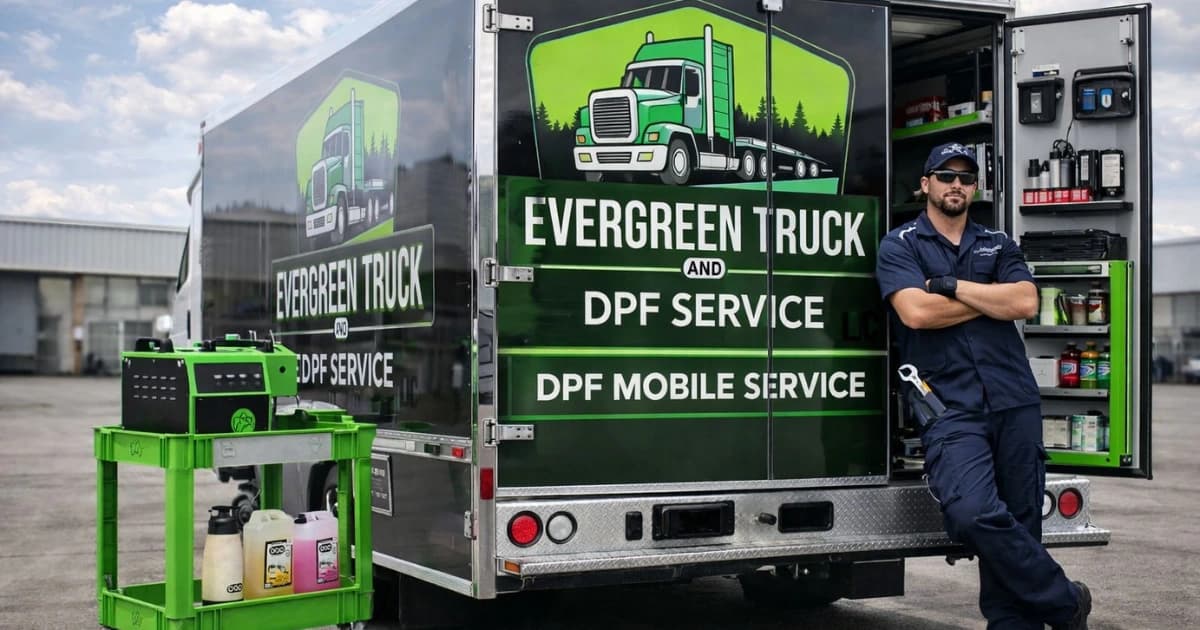
Evergreen Truck DPF Services was built around the specific needs of Ontario’s trucking community. We are not a fixed facility that requires you to tow or drive a compromised truck to our location and leave it for days. We are a fully mobile operation that brings professional-grade aftertreatment system service to your truck wherever it is parked in Ontario.
Why Mobile Service Is the Right Model for Ontario Fleets
Ontario is a large province with a highly distributed trucking industry. A fleet based in Mississauga operates differently from a carrier staging out of Sudbury or a grain hauler working the Chatham-Kent agricultural corridors. Fixed service centres work well for dealerships that have guaranteed service volume, but they impose significant logistical and financial burdens on fleet operators who need to get their trucks back on the road as quickly as possible.
Mobile DPF service eliminates the towing cost, which for a disabled Class 8 truck in the GTA can run $500 to $1,500 per event. It eliminates the lost revenue from a truck sitting at a service facility for two to five business days while waiting for a service slot and parts. And it eliminates the scheduling complexity of coordinating driver pickup, loaner vehicle arrangements, and redelivery for multiple trucks across a large fleet.
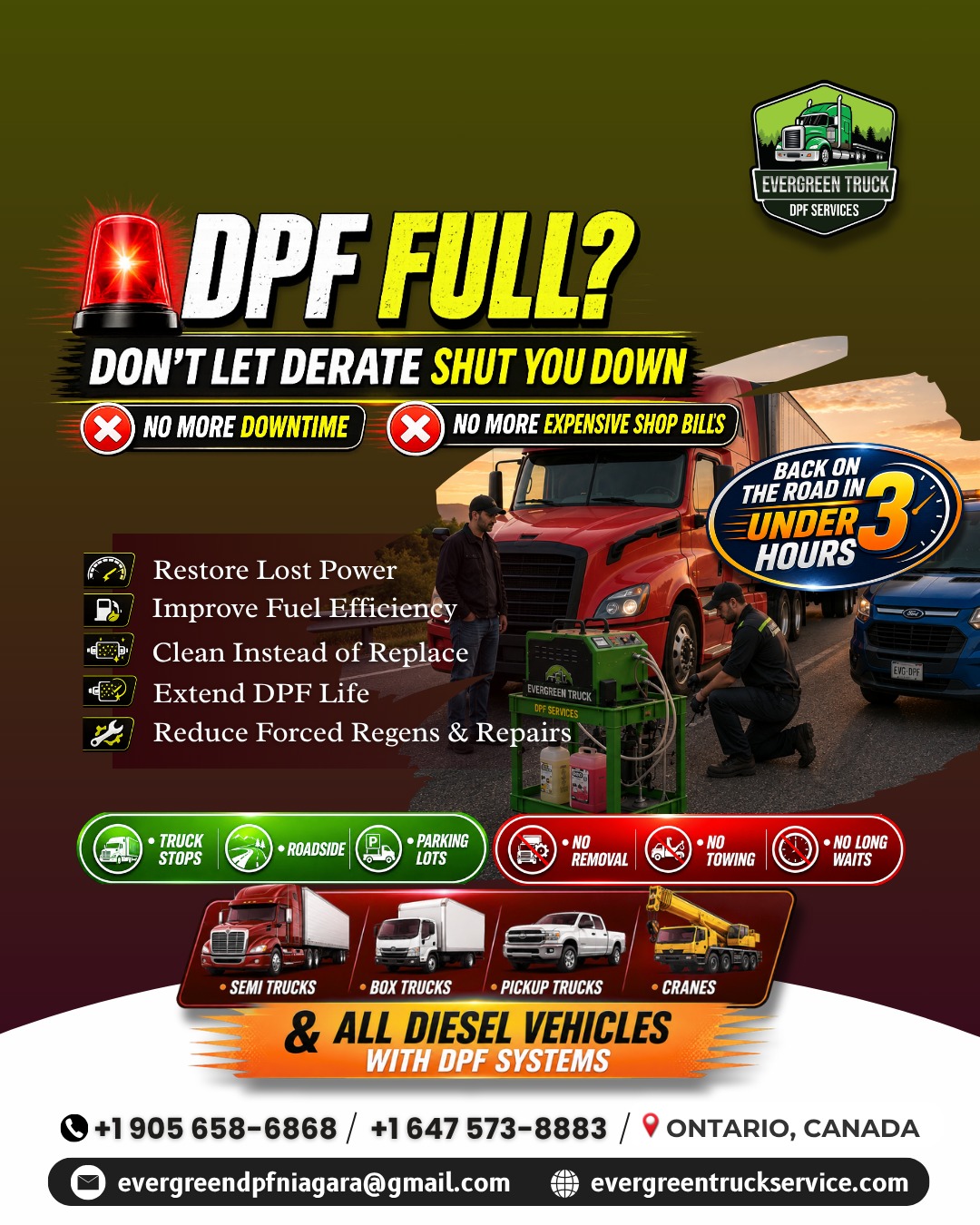
With Evergreentruck Service, the process is simple. You tell us where the truck is. We come to that location with our mobile service unit. We complete a full aftertreatment system service—covering the DPF, DOC, SCR system, EGR valve, turbocharger inspection, and combustion system assessment—in under four hours. The truck drives away. Your driver stays productive. Your fleet keeps moving.
Complete System Coverage, Not Just the Filter
One of the most common mistakes made by lower-cost DPF service providers is cleaning only the diesel particulate filter without addressing the broader aftertreatment system context. A DPF returned to service inside a system with a degraded DOC catalyst, a partially blocked EGR valve, or injector fouling affecting combustion quality will re-clog at an accelerated rate. The root causes of excessive DPF loading have not been addressed, and the operator is back in the same situation within 30,000 to 50,000 kilometres.
Evergreen services all six components of the aftertreatment system in a single visit. This comprehensive approach addresses the actual causes of DPF loading, not just the symptoms. It also means that our service records give fleet managers a complete picture of aftertreatment system health across their fleet, enabling smarter maintenance scheduling and earlier detection of developing problems before they become expensive failures.
Fleet Programs and Winter Preparation Packages
Evergreen offers structured fleet service programs for Ontario operators managing multiple units. We can schedule regular visits to your yard, service multiple trucks in a single visit, and provide detailed condition reports for each unit serviced. These records support your maintenance documentation requirements and give your fleet manager clear visibility into which trucks are approaching service thresholds before they start costing you money.
For the pre-winter season, Evergreen’s winter preparation packages are specifically designed to audit and service your aftertreatment systems before the demanding November-to-March period begins. The logic is simple: entering winter with clean, fully functioning DPF systems means your trucks start the cold season from the best possible fuel efficiency baseline. They handle the additional soot load of cold-weather operation without immediately entering the penalty zone, and your fleet reaches spring without the accumulated inefficiencies that compound across months of deferred maintenance.
Building a DPF Maintenance Culture in Your Fleet
The most effective fleet managers treat DPF health the same way they treat oil change intervals and tire pressure monitoring—as a non-negotiable operational baseline, not an optional extra. Building this culture requires clear communication with drivers, consistent tracking metrics, and a service partner who makes compliance easy rather than burdensome.
Drivers are often the first to notice early symptoms of DPF loading: slightly sluggish acceleration, more frequent active regeneration notifications, marginally higher fuel consumption reports. Creating a reporting culture where these early signals are taken seriously—rather than dismissed as normal variation—allows fleet managers to schedule proactive service before a minor filter loading issue becomes a full service event or a roadside failure.
Monthly fuel consumption tracking by individual truck is the most powerful early-warning tool available to fleet managers. A truck whose fuel economy begins trending two or three percent worse than its established baseline should trigger a DPF inspection, not a wait-and-see approach. The cost of an inspection is minimal. The cost of discovering a heavily clogged filter after six months of degraded fuel economy is substantial.
Evergreen supports this approach by providing clear before-and-after flow data for every truck we service, giving fleet managers a documented performance baseline for each unit in their fleet. When fuel economy begins to drift, you have a reference point that tells you exactly where the truck’s aftertreatment system was performing at its last service and how much degradation has occurred since.
Take Action Before Winter Arrives
Ontario winters are not going to get easier on your fleet’s aftertreatment systems. The combination of cold temperatures, urban congestion, fuel gelling, and failed regeneration cycles is a structural challenge that every Ontario truck driver,fleet manager deals with every year. The variable you can control is how well-maintained your DPF systems are when that season begins.
The fleet managers who come through Ontario winters with their fuel budgets intact are the ones who scheduled their DPF cleaning before December, not after the first string of limp-mode events in January. They are the ones who know exactly which trucks in their fleet are approaching service thresholds because they have the data to tell them. And they are the ones who have a mobile service partner who can come to their location, complete a full system service, and get their trucks back on the road without disrupting their operations.
That partner is Evergreen Truck DPF Services.
Contact Evergreen Truck DPF Services
• Phone: +1 (647) 573-8883
• Website: evergreentruckservice.com
• Mobile service across Ontario — we come to your location-Anywhere,Anytime
• Full aftertreatment system coverage: DPF, DOC, SCR, EGR, turbocharger, and combustion system
• Service completed in under four hours
• Same-day scheduling available
• Winter prep packages for fleets of all sizes
Don’t let this winter be the one that breaks your fuel budget. Schedule your DPF audit today.